The CutestCamera
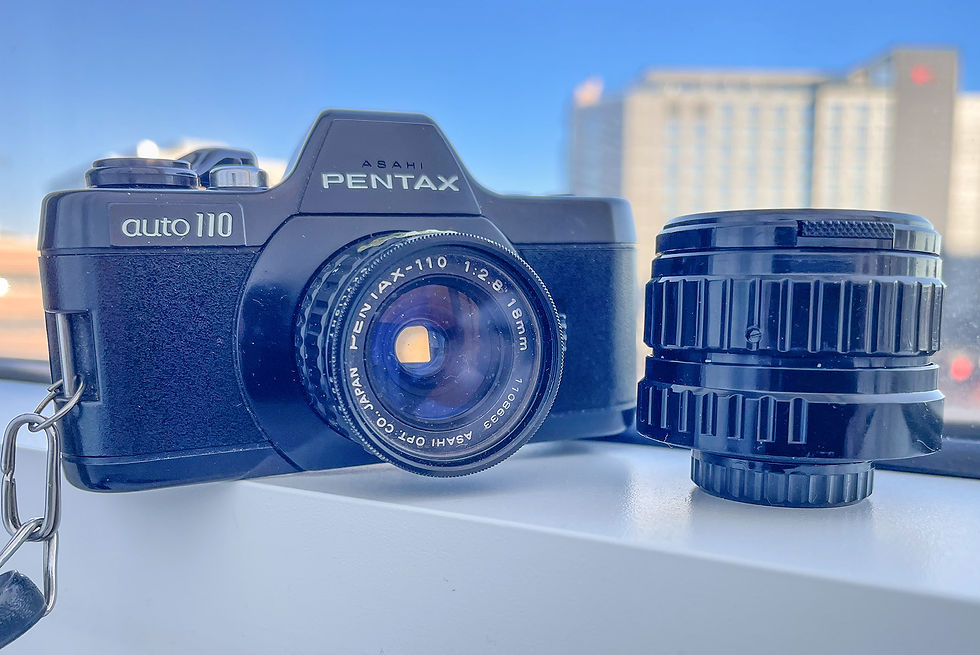
Humans are hardwired to like little things… especially when they look like bigger things. That’s why we love our babies even when they wail and poop. We love kittens… even when they bite and cause havoc. And many of us love the cute little Pentax Auto 110… even though it… well… we’ll get to that.
Kodak released the 110 film format with their “Pocket Instamatics” in 1972. These are the candy bar shaped cameras that recorded the childhoods of so many Gen-Xers. The wizards of Rochester achieved pocketability by slicing their 126 cartridge in half and loading it with 16 millimeter film. Many of the cameras were cheaply made… plastic of body and lens. However, some manufacturers worked hard to make excellent photographic tools designed to wring every bit of quality possible from 110’s little 13 by 17 millimeter negative.
Kodak, Canon and Minolta each made standard pocketable cameras with quality lenses, rangefinder focusing and accurate automatic exposure. Minolta also upped the game with two models of 110 SLRs with permanently attached zooms. Their last model looks eerily like a modern day digital bridge camera.
If you saw anyone using one of these quality 110s today… you might say, “Oh…” but you wouldn’t saw, “Awwww!” They’re interesting. They’re little… but they don’t spark joy. No… for the photographic equivalent of a basset hound puppy, you have to turn to the Pentax Auto 110. It literally looks like an SLR made for a four year old child.
The petite Pentax is not just adorable. It’s a real system camera with five prime lenses, one zoom, a proprietary flash and even an auto winder. The standard model came out in 1978 with three lenses, a moderately wide 18, a normal 24 and short telephoto 50 millimeter lens. Four years later Pentax released the improved Auto 110 Super along with three more lenses… a focus free 18, a 70 and a 20 to 40 zoom. Every “System 10” lens has an f-2.8 maximum aperture… but you won’t find an aperture ring… or even a diaphragm. That’s one of this cutie’s many quirks. The F-Stop is set in the body, rather than the lens by a combination shutter and aperture. The aperture itself is square and sometimes produces interesting bokeh boxes.
So… what’s it like to shoot with world’s most fetching photo system? Well, as you can imagine, a camera right sized for a four year old is wrong-sized for a grown-up. Plus… the film wind lever takes two strokes to advance the film and cock the shutter. Half the time I forget the second stroke. The auto-winder solves both of these problems with a healthy dangly bit to grip and a quick motorized advance to the next shot. That’s fine, until the fragile tab on the winder’s battery door breaks off. I’m on my third winder. I will say that even though the little Pentax feels very frail… mine has proved very durable… except for the winder battery compartment. Once you get used to the tiny size, the camera really is fun to use. The viewfinder is very bright. Focus is snappy with a split image rangefinder. The Auto-everything exposure seems to be very accurate with a green light for GO and a yellow light for “Slow Down and Get a Tripod.” The tripod mount is way over on the right side, but with a camera this light it’s fine.
My copy of the Auto 110 came from a thrift store. Believe or not, I found it in the toy section for five bucks. On eBay today, they aren’t that cheap, but they aren’t as expensive as they used to be. My favorite lens is the 18mm, equivalent to a 35. Not only is that my favorite focal length, but the 18 is a little bigger and looks and feels better than the normal 24. I also have the 50 millimeter and hardly ever use it.
God bless Lomography for keeping 110 film alive. They sell several standard color and creative emulsions for about 10 bucks a roll. There’s even a black and white film. I’m lucky that my local camera store in Knoxville, Tennessee develops 110 film in house. DIYers can find 110 ready Patterson reels, if that’s your thing.
With its good glass and accurate exposure system… the bantam Pentax should be able to push above it’s weight and get the very best quality you could hope for from the 110 format. And, I guess it does… but therein lies the rub. The best you can get from a 110 negative is still just not very good. The scans and prints look just like you remember from your Aunt Karen’s scrapbook… plenty of grain and blocky shadows. That’s great when that’s what you’re looking for. But when the nostalgia wears off, I would rather have a grown up camera.


Comments